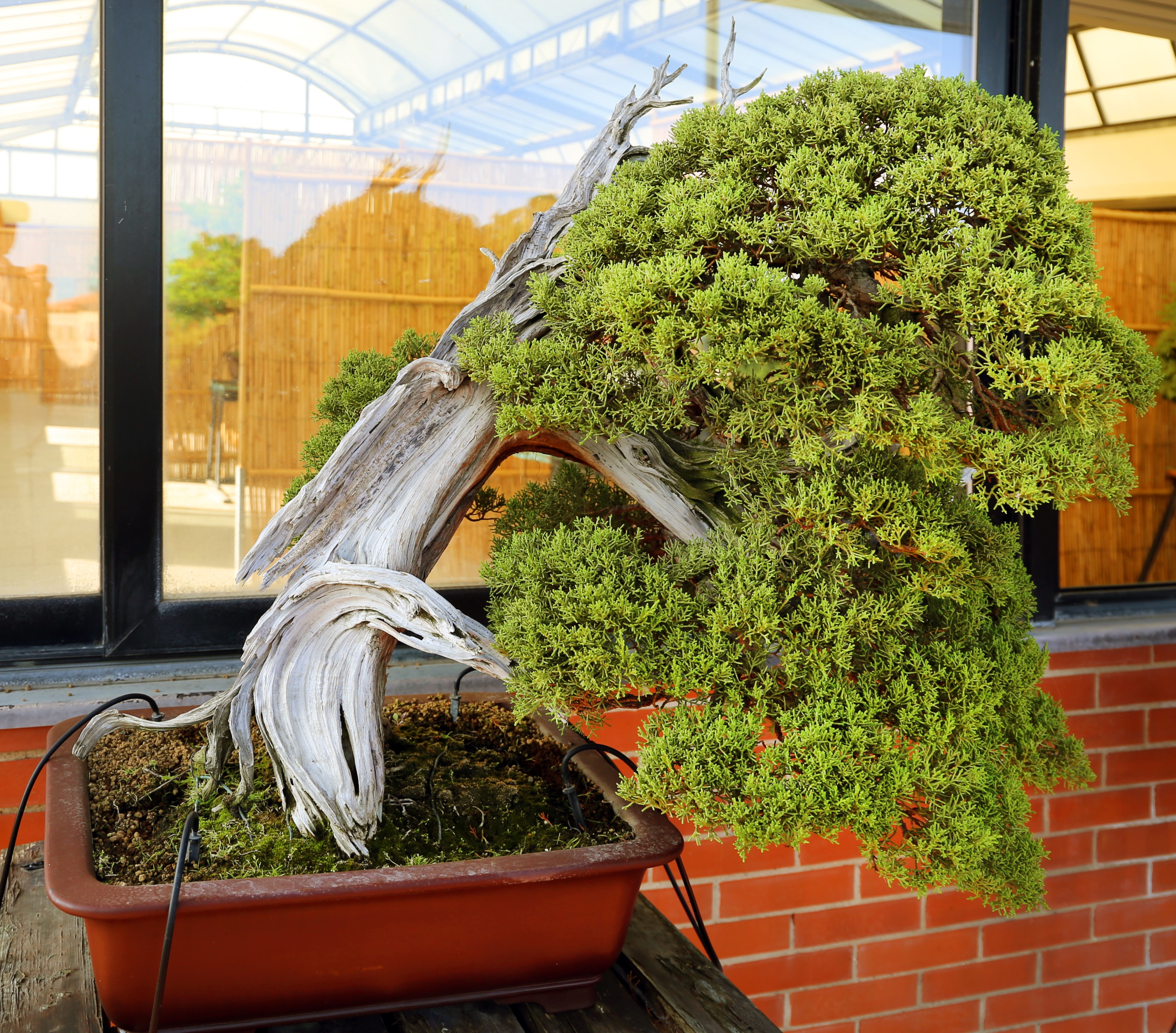
This Chinese juniper is presented in the slanting, or shakan, form, but its design also carries a strong windswept character. The trunk rises from the left side of the rectangular pot and drives decisively to the right, while nearly all the living foliage occupies the same side. A large area of negative space remains behind the movement. The pot’s visual weight and the firmly planted base prevent the composition from appearing ready to fall, creating tension without losing stability.
Chinese juniper, Juniperus chinensis, is an evergreen conifer native to eastern Asia. Depending on its age and cultivar, it can carry juvenile needle-like foliage, mature scale-like foliage, or both. Its mature bark can peel in strips, while sections that have lost their living tissue may weather into pale deadwood. The photograph’s source identifies this museum specimen as coming from China and approximately 50 years old, but its acquisition date, cultivar, training history, and present condition are not provided.
The most expressive feature is the relationship between deadwood and living growth. A broad silver-gray section follows the trunk’s bends, while a narrower live vein appears to continue toward the dense green canopy. The deadwood suggests exposure and past damage; the foliage records survival. Although carving and careful branch placement were likely involved, a photograph alone cannot distinguish naturally formed features from the artist’s later refinements. The strongest design decision is the concentration of visual mass in the direction of the trunk’s movement.
Chinese juniper should be cultivated outdoors with abundant sunlight, fresh air, and a free-draining substrate. Water thoroughly when the soil begins to lose moisture, but do not keep the roots continuously wet. Preserve healthy green growth when pruning because bare juniper branches may not reliably produce new foliage, and inspect wire frequently so it does not scar the expanding live vein. Feed during active growth, repot according to root condition rather than a fixed calendar, and protect the containerized roots during severe winter cold. Exact timing must reflect the local climate, the tree’s health, and its stage of development.